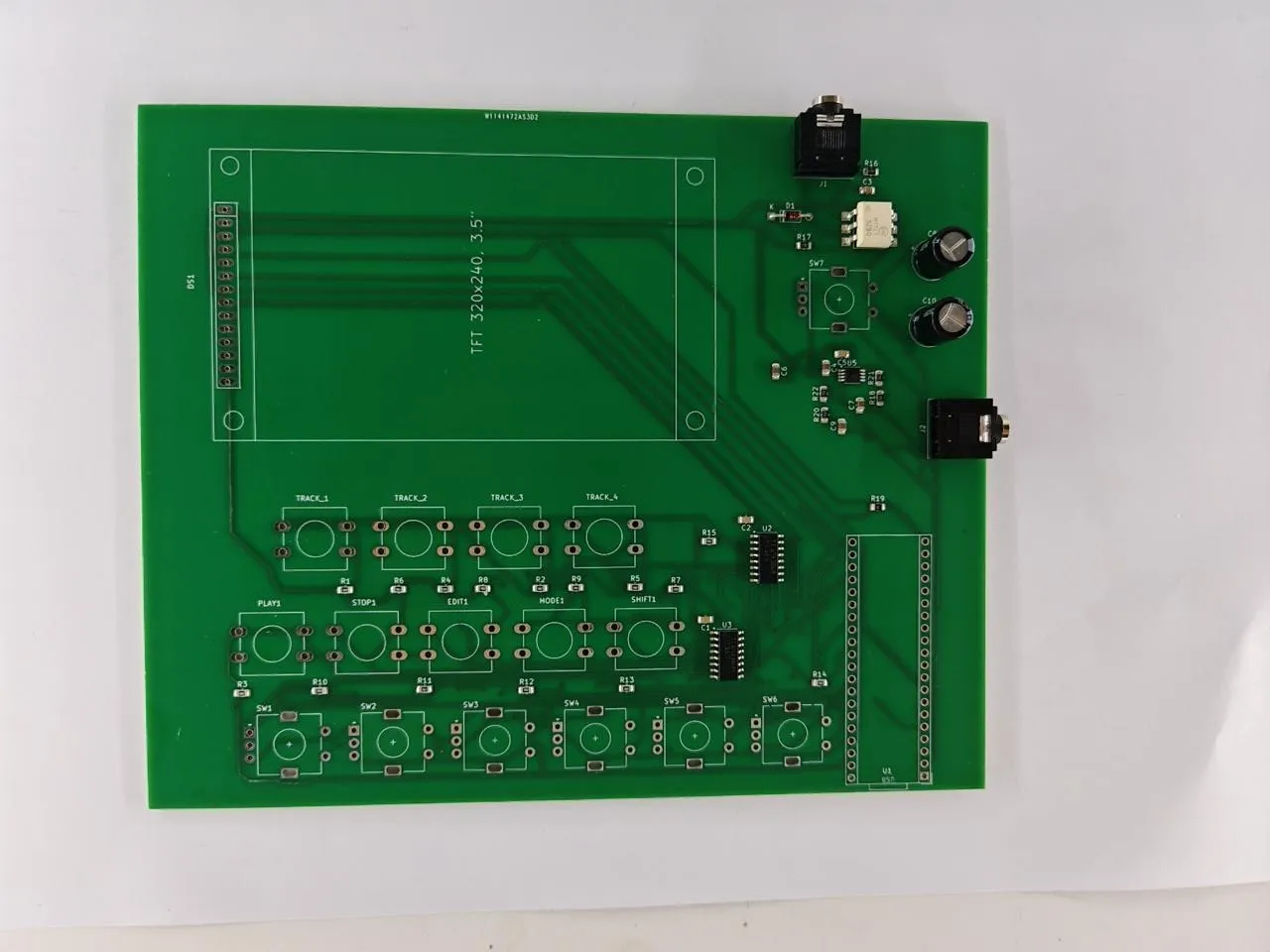
Our first circuit boards are now on the way. It is a simple sentence, but it marks a major change in how we can develop Viberoo Seeq: the instrument is about to become one connected piece of hardware rather than a collection of modules, jumper wires, and temporary controls spread across the workbench.
From a working circuit to an instrument
The breadboard prototypes have already answered many of the important early questions. We know the display works with the embedded processor, the controls can be read reliably, USB MIDI reaches the firmware, and the audio engines can run alongside the sequencer and interface.
The PCB brings those tested parts into the physical arrangement intended for the instrument. It carries the display and processor, the navigation and performance controls, and the audio and data connections in one repeatable design. That lets us stop testing each subsystem in isolation and start learning how the complete machine behaves.
Firmware is roughly 80% complete
While the boards have been prepared, firmware development has continued on the current hardware setup. The core instrument is now in place: multiple synthesis engines, patch loading, six-voice chord playback where the engine supports it, the 64-step sequencer, four directly accessible patterns, queued pattern changes for live playback, MIDI control, delay and reverb, and the main performance screens.
That puts the firmware at roughly 80% complete. The remaining work is less about proving the basic concept and more about integration and refinement. We still need to complete features such as pattern automation and project storage, validate every control on the new board, tune the audio and interaction details on the assembled hardware, test longer sessions, and work through the edge cases that only appear when everything runs together.
The first real prototypes come next
Once the boards arrive, we will populate and bring them up carefully: verify power first, then the processor and display, followed by controls, MIDI, and the audio path. From there we can install the current firmware and begin testing Viberoo Seeq as a complete instrument inside the prototype enclosure.
This is the stage where assumptions turn into things we can touch, hear, and measure. Control spacing, screen readability, output levels, noise, timing, thermals, and assembly all become real engineering questions rather than drawings or simulations.
There will almost certainly be adjustments after the first units are assembled—that is exactly what these prototypes are for. But with the boards in motion and most of the firmware already running, the gap between the browser prototype, the breadboard, and a self-contained Viberoo Seeq is getting much smaller.